
May I intoduce you to Maud Russell:
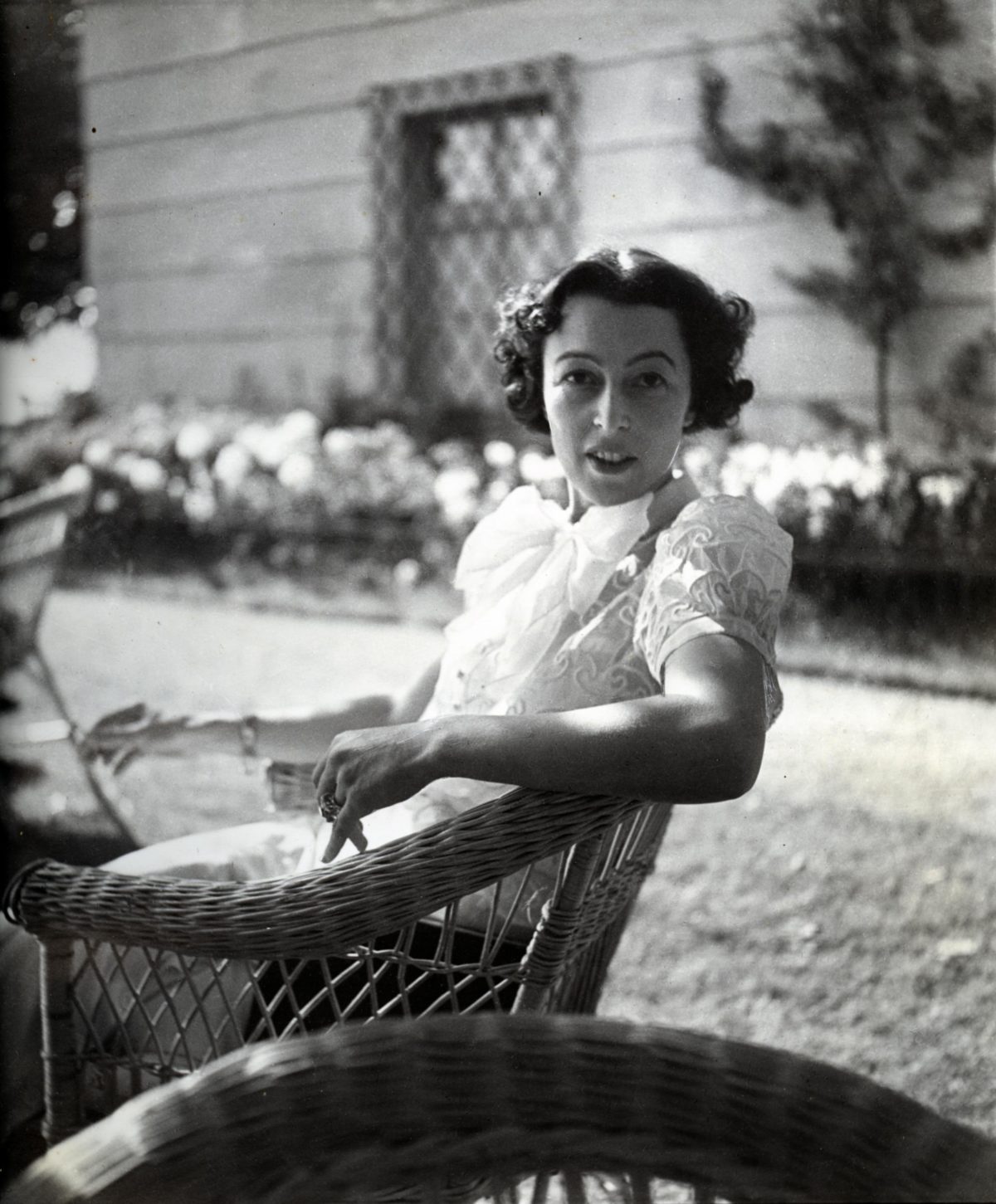
Look at that pose. She has “don’t mess with me” written all over her. Mouth slightly open with just a hint of a smile, eyebrows raised, eyes staring straight at the camera, pinkie finger raised even in repose, an enormous stone on her wedding finger, and a slightly quizzical look. A beautiful woman, wealthy and confident. She gets what she wants, and what she wants is to be the centre of attention. If I can get all that from the photograph, I can only imagine what she must have been like in person.
Maud married Gilbert Russell. There is no point introducing you to him as the story is about her, as most stories usually are. Gilbert’s talent was for making money, a lot of money. Maud’s talent was for spending it, a lot of it, and for making friends, mostly male it seems, and making sure she was a key figure in the bright, sophisticated social scene of the 1930s.
She knew she needed a home that was her equal. It should exude great style and taste. Its centre piece should be a showstopper of a room where great parties could be held, a place where people wanted to be invited, a place where people wanted to be seen.
She found it in 1934 in the form of Mottisfont Abbey. It wasn’t glamourous then, but she knew she could make it something very special. Calling it an Abbey was somewhat of an affectation, although it did start out that way, back in 1201. But after Henry V111 wreaked havoc with the monasteries it was turned into a Tudor style home, built over and abutting the original Abbey. Today, thanks to a previous owner who completely remodeled the exterior, it now looks like a Georgian style home.

The drought and the ban on the use of hose pipes has taken its toll everywhere in England, and nowhere more so than at Mottisfont Abbey. Sadly, it is left up to the viewer to imagine how it should look, surrounded by beautiful green lawns, freshly cut and lovingly tended. Maud would not be happy with how it looked now.
It has to be said, by me anyway, that even with a perfect lawn in front, the house is perhaps a little dull from the outside, but Maud quickly made sure that the inside was anything but.
But first she set her sights and Gilbert’s money on the outside, creating a spectacular walled rose garden.
The photos on the National Trust website make the gardens look worth the trip.

It was to be the highlight of our visit. The Fabulosity Meter was primed and ready. Notice the use of the past tense. The heat had done its work here too, the roses had bloomed early, and all we saw was the occasional bloom valiantly hanging on to a sad looking rose bush. The Fabulosity Meter took one look and went back in its box
But inside the house it is a different story. Beautifully cared for and restored by the National Trust, it is presented exactly how Maud wanted it to be seen, worthy of the Fabulosity Meter’s applause. When she first saw the house, she knew immediately that what was the large rather austere looking entrance hall, could be transformed into the showstopper of a room that she needed. Something quite magical, that would put Mottisfont Abbey firmly on the map and seal her place at the very top of society’s gem encrusted ladder. She knew how she wanted it to look – she just had to find the person who could make it a reality.
Enter Rex Whistler, a fey young man, just turned thirty and one of the “Bright Young Things” of England.

Already famous for his trompe-l’oeil murals and much to the surprise of many, his consummated fling with Tallulah Bankhead, he was just what Maud was looking for. And she was exactly what Whistler was looking for – he was instantly besotted. It is thought that Maud did not encourage him. But their relationship was often referred to as “complicated”, a word that says little but implies a lot.
She told him of her plan to transform the entrance hall into a spectacular Gothic-style drawing room. He knew he could do it, and he did. He totally reimagined the room using nothing but paint, a paintbrush and his wonderous talent for trompe-l’œil, the highly realistic illusion of making the objects in a painting look three dimensional and totally real.

It’s not until you get closer that you fully understand exactly what he has done:

There is no carved stone or molded plaster. The walls and the ceiling are flat. Everything is just done by painting. Even the pelmets over the top of the windows are painted, as is the lining of the curtains which you can see on the edges. Nothing is real. It is all a wonderful sleight of hand. Whistler’s hand.
But Whistler was getting bored. Maud had demanded that everything was painted in this monochrome color. He begged her to let him add some real colour, but she refused. Then one weekend when Maud was away, he painted a panel as he really wanted them to look.
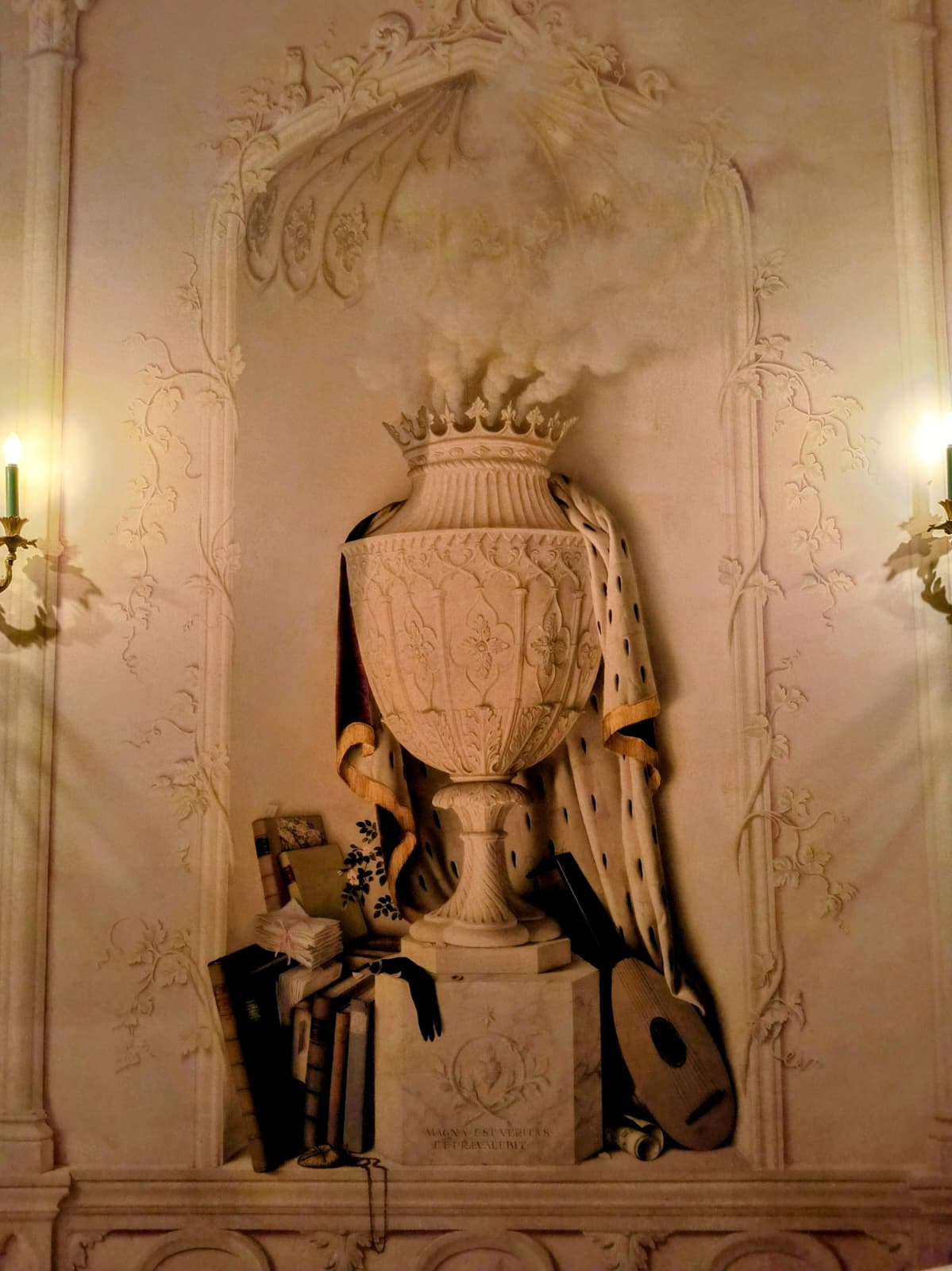
Even the smoke is painted
When Maud returned, she was furious and wanted him to paint over it. But he explained that he had personalised the mural to illustrate Maud’s interests. She loved to read, and play the lute, so he had included those along with the bundle of letters that Gregory had written to her. The ermine was there because it was her favourite fur, and the puffs of smoke represented her well known distaste of bonfires. It worked, and the mural is still there to remind us all of Maud Russell.
He was still working on the room on September 3rd 1939. He was perched on top of scaffolding with his paintbrush in hand listening to his transistor radio when he heard the announcement. Dipping his brush, he wrote a message on top of the cornice by the bay window: “I was painting this ermine curtain when Britain declared war on the Nazi tyrants, Sunday, September 3rd. RW”
He felt the call of duty. He wanted to serve.
He left his work unfinished but painted a tiny can of paint and a paintbrush on the cornice of the room to signify that he would return to complete it.

He nearly made it.
But tragically he was killed by enemy fire on July 14th, 1944. Shortly after D Day and just months before the end of the war.
The mural he created for Maud was his last work.
It is known as “The Whistler Room”.
 Andrews Fabulous Travel Blog