
Huttleston Broughton. Can you imagine going to school with a name like that. I bet he breathed a huge sigh of relief when he was made Lord Fairhaven. But I digress.
Huttleston Broughton, Lord Fairhaven, died in 1966. It came as a shock to absolutely no one that he died without an heir. There was no Mrs Broughton and never was, and was never likely to be. Nor was it at all likely that there would be a bastard son hiding in the bushes waiting to claim the title and the fortune. So Lord Fairhaven’s much loved Anglesey Abbey was left to the National Trust. But there was one proviso. It should be kept and presented to the public just as it was when he lived in it.
The National Trust has has honored that request, even adding touches of whimsy, such as leaving a half smoked cigar next to this writing desk, to make it look as if he has just popped out for a pint of milk.
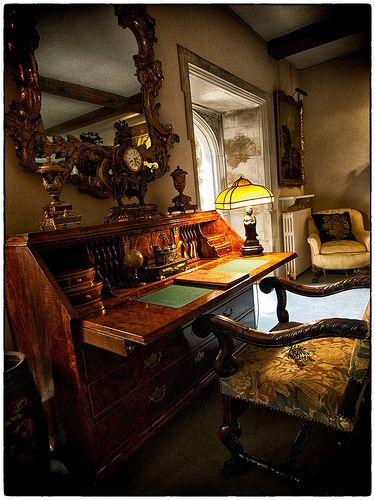
But, not wanting to spoil the moment, lets start with the fact that Anglesey Abbey has never really been an Abbey. It was first built as a hospital in 1135. But no one is going to call their home Anglesey Hospital. Its first reincarnation was early in the 13th century, when it was converted into a priory of Augustinian canons. So today it could be called Anglesey Priory, which has a certain ring to it , but it makes it sound kind of small. And besides homes that are priories are two a penny in England. But a home that is an Abbey. Now that is something special. Anglesey Abbey sounds grand. And we all love a touch of grand. Well I certainly do.
So Anglesey Abbey it became, but we are leaping ahead of the story by many centuries.
In 1536 Henry VIII began the Dissolution of the Monasteries and promptly threw the canons out of their priory and granted the building to a lawyer, John Hynde. And we all know what lawyers are like. And John Hynde was no exception. He wasn’t interested in an old priory. He just wanted the roof. So he quickly removed it and reused it in a new mansion he was building at Madingley Hall. He never returned to the Priory. He just left it to decay.
The building then lead a rather sorry existence for centuries until Huttleston, soon to become Lord Fairhaven, laid his eyes and his fortune on it in 1926. He lived there for forty years and turned it into what he wanted – a place to inspire others. He filled it with antiques. He bought furniture, he bought china, he bought paintings, tapestries, statues, anything that caught his eye. There was no one period that interested him, no one style. He was interested in it all. With no curator and unlimited funds, his motto seemed to be “see it, love it, buy it”. And he did. All the time! The house is a jumble of eras, a jumble of styles, and it is a delight because of it. Every room, every table, every shelf has something that catches the eye.
But it is not just the collection. The house itself is quite wonderful. As soon as I step through the front door I know the Fabulosity Meter is going to be happy

Definitely not your average entrance hall.
The first drawing room (every house should have more than one!) was home to some of the many clocks he had collected. The pagoda clock is perhaps the most famous
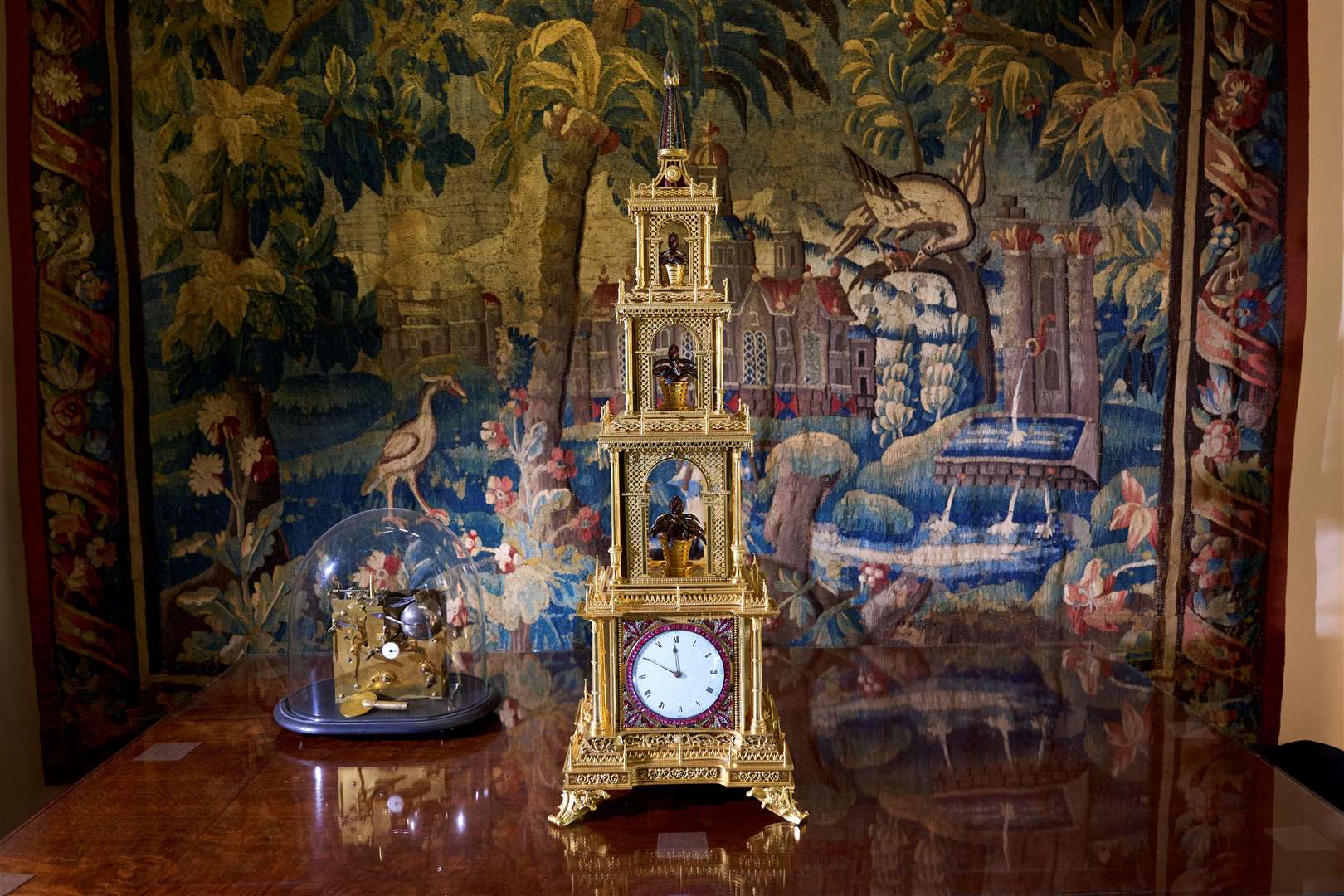
Not only does it tell the time, but every three hours it puts on an automated spectacle: twelve tiny bells play a tune while three jewelled pineapple plants on each tier of the pagoda lift from their pots and spin around.
There is also this tapestry

And yes, that is a tapestry of the Abbey. Everyone can commission a painting of their home, only Lord Fairhaven would or could commission a tapestry!
Drawing Room number two is just next door. The Oak Room is described as the more informal drawing room, although it looks anything but informal with its amazing ceiling:
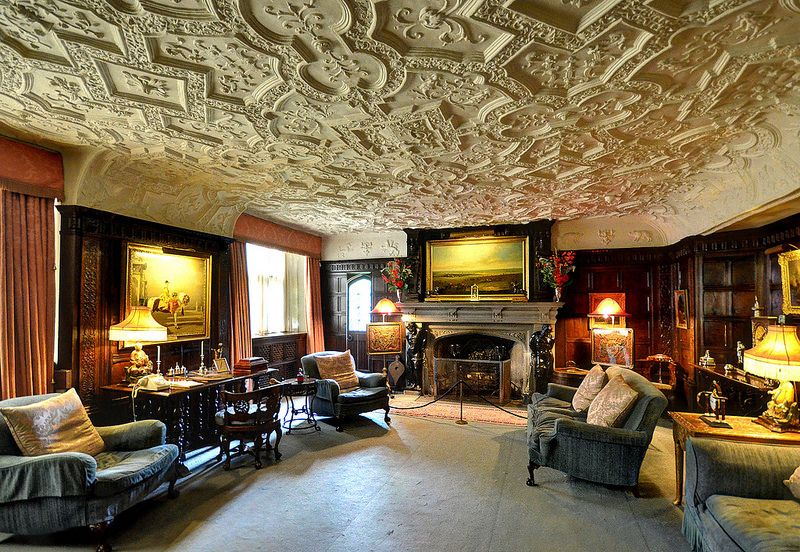
The ceiling may look as if it has been there for centuries, but it hasn’t. Lord Fairhaven was visiting an Inn at Banbury which had the original ceiling. He loved it. He wanted it. As one does. At least one might. But one can’t actually have it. Lord Fairhaven could. He had all that money and he had all those contacts. He actually tracked down the original mold for the ceiling and had another one cast for the Oak Room. It wasn’t quite the right size but with a little nip here and tuck there he made it fit. And that dear reader, is what money can do. “See it, love it, buy it’!
Another example of just that is the Library

A spectacular room with an impressive collection of Antique books to be sure, but what is more impressive is the bookcases themselves. The shelves were made from elm timbers rescued from the foundation piles of Waterloo Bridge when the bridge was destroyed in 1934.
But my favourite room was the dining room.

No, that is not it. That is just the entrance to the dining room. Well if you want to impress your dinner guests that is certainly the way to do it. And in no way does it prepare you for the room itself, although you can see it peeking through the doorway. Once the actual entrance to the house, now a breathtaking dining room with an Italian Renaissance refectory table in amongst the original arches of the priory.

Fairhaven liked to entertain, and he had dinner parties almost every evening. But they were usually limited to just four guests. He felt that if there were more than four at the table then some guests would be excluded from the conversation. Wealthy and smart. Quite the combination!
And that brings me back to his little foibles that I talked about in my previous post. Dinner was always served promptly.
……… at 6:05.
Not at 6 o’clock.
That was a little too early!
In the kitchen there still hangs a typewritten list of instructions for the staff, with exact times of everything, including the time Lord Fairhaven will appear in the Long Gallery “to select his carnation buttonhole for the day”
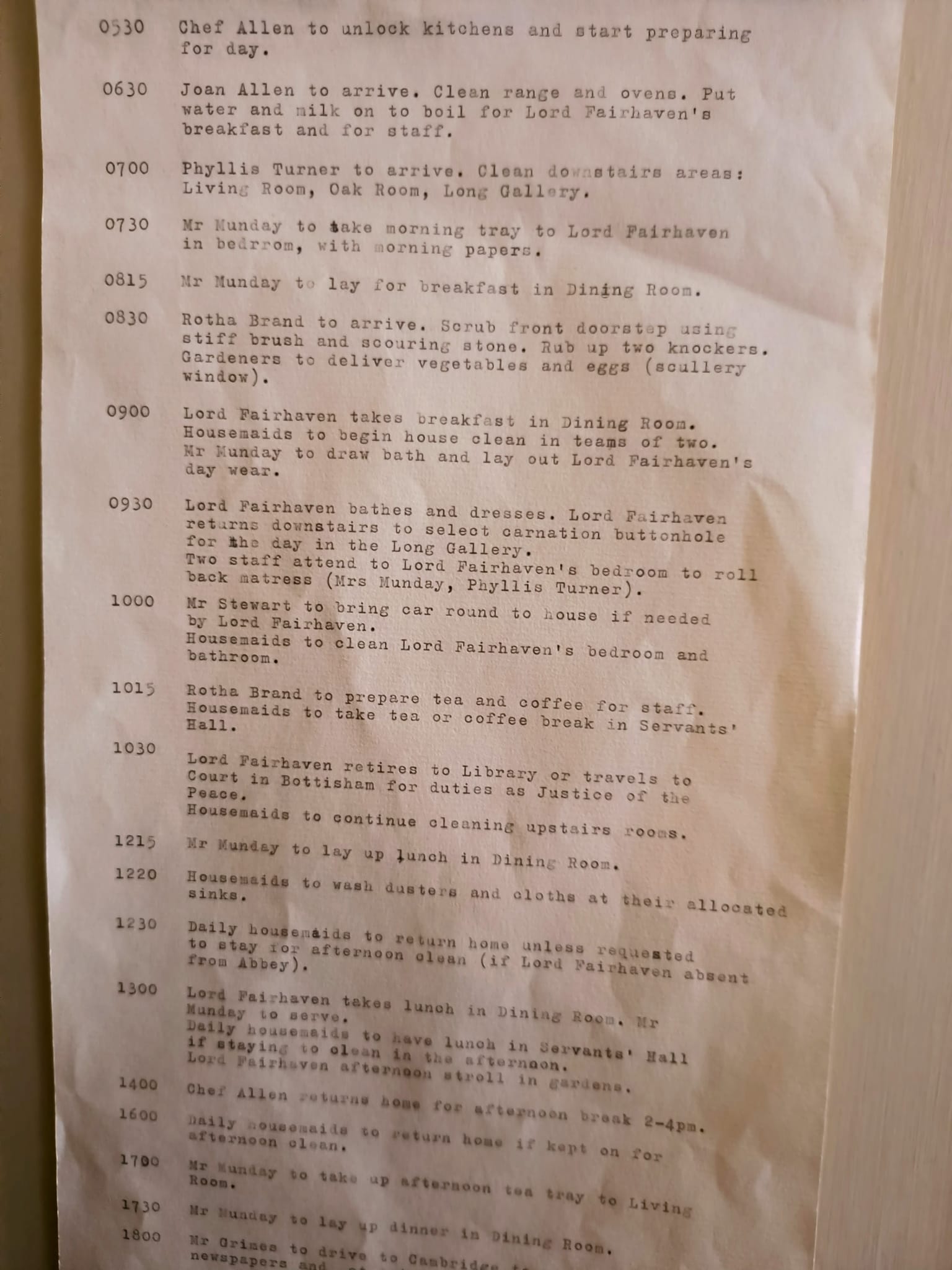
Time was very important to him, perhaps that is why he had so many clocks. And the staff were very important to him, perhaps that is why they stayed with him for so long, and why so many decided to stay on after he died and work for the National Trust.
But most important of all was Anglesey Abbey. Not Anglesey Priory, and certainly not Anglesey Hospital. And that is exactly why he left it in the hands of the National Trust. He wanted to preserve for the nation “the home of an English gentleman, a way of life which is fast disappearing in the modern world”.
 Andrews Fabulous Travel Blog
Great story. Love the place! I Enjoy reading your adventures. Cheers Evan. 🥇
Thanks Evan
Congratulations Andrew, what a lovely description of the wonder that is Anglesey Abbey. Having visited that impressive pile a number of times myself I am impressed you have captured images of so many rooms sans other people – did you break in before opening time or shout ‘fire’ to ensure others made a swift exit? It should also be noted the extensive grounds around the Abbey are gorgeous and a joy to wander through. It really is a memorable location. Thank you for sharing it with us.
Alfredo
Thanks Alfredo. Wasn’t I clever getting those photos with no people in them. Actually it was my cheapo phone that has some sort of IA editing thing where it asks you if you want to edit out anything – and pouff, the people are gone. I have no idea how it works, and I am absolutely amazed that I have managed to make it work!
so happy to be hitching along. Fascinating history. That schedule is alarming though.
I love the mix of periods and styles. And he must have treated his staff very well to have them stay on for so long. How you treat people is a type of prayer.
What an absolutely wonderful thought, John: how you treat people is a kind of prayer .
I liked the instructions – I should incorporate some of them…