
The next morning Preesh is gone. It was not his choice. His driving was excellent, his customer relations were not.
A discussion was held with the tour company. It was not a pleasant discussion. But this morning a new driver turns up to meet us. His name is Desha. His customer relations are excellent, his driving is not. He arrives in a Toyota transit van that has seen better days. It is not nearly as comfortable as Preesh’s Prius. But we can’t keep complaining.
We are going to see the The Dambulla Royal Temple Cave. It is a two hour drive, but we see little of the scenery. Desha drives as if he has a death wish. It might work for him, but we want to live. We are gripping onto our seats and each other, with our eyes clamped shut. Meanwhile Desha talks a lot, and seems to use the car horn as punctuation marks. He tells us that he is not really a driver. Well, he got that right. He is the company’s top tour guide and has been sent to make sure we are happy. So far, not so good. He is usually on a coach with a driver and assistant, with 20 to 30 passengers. He tells us that by day three everyone loves him, and he has them eating out of his hand. I manage to say nothing, and as you know by now, that’s not easy.
On top of a small hill overlooking the town of Dumbulla is a huge rock that stands 525 feet tall. The rock is home to five caves that unbelievably were carved out of the granite by Buddhists monks in the 2nd century BCE. The caves were made to provide shelter to the monks during the monsoon season. They even carved a drip line into the overhang above the caves to keep them dry
A couple of hundred years later the King of Anuradhapura was forced into exile and the Monks offered him shelter and safety from his enemies. He stayed with the monks for 15 years before he was able to return to his throne. In gratitude to the monks, he had the caves carved larger and turned into a magnificent temple
Desha drives into the car park, finds a nice shady spot under a tree, and parks the van. The fact that he has blocked in several other cars doesn’t seem to bother him. But it does bother the parking attendant who bangs on the window and tells him to move. Desha gives him a look that might slay a lesser man, but you can’t mess with a parking attendant.
Desha moves the van.
He tells us that the caves are a twenty minute hike. I don’t do hikes at the best of times, but this is not the best of times. I have strained my achilles tendon and have been hobbling around rather slowly for days now, like some old man. (Quiet in the back!). Gordon tells Desha this, and asks him to walk slowly. But Desha walks like he drives. Slow is not a speed he recognises. And this is not a hike. It is a climb, which includes 370 stone steps.

Yes, I counted them. I needed something to take my mind off my heel, and Desha’s behaviour. Note, he is already so far ahead that he doesn’t even appear in this picture. It takes me a while. When I get to the top Desha is in conversation with another guide. He tells him that we are planning to climb Lion’s Rock tomorrow (more on that next time!) and then points at me limping across to him. Does he really think I can’t hear him? Lame I might be, deaf I am not! They laugh
At the top, Desha in true tour guide fashion gathers us both around as if we were a group of 20 and starts telling us the history of the caves. From where we are standing all we can see is this

I ask him if everything was built in the 1st century and he assures us it was.
What about the colonnade, I ask.
Yes that was built in the first century by the King!!
Obviously that is not the case. I check Wikipedia on my phone. The colonnade was built in front of the caves in 1938
So, not only is Desha not a good driver, he is not a good tour guide either.
Desha leads the way through a pair of doors into the first cave.

Even before we step foot in it, it is mind blowing. This is not the largest of the caves, but considering it was carved out of the rock by hand it is truly impressive.
It is known as the “Cave of the Divine King.” Over the entrance there is a 1st-century Brahmi inscription giving an account of the founding of the monastery
Buddhas line the walls while a stupa surrounded by more Buddhas sits in the middle of the cave

Most of the statues date back to the 1st century but more were added in the third century. Some were carved inside the cave which makes it all the more impressive. The walls and the ceiling were painted in the 1600’s.
Desha gathers us around him again. As a tour guide he is used to being on a tight schedule, leading the group around, stopping where he wants to stop, giving them information (often wrong!), before moving on to the next prescribed stop. At the end he might give you 10 minutes to take photos.
He obviously expects to do the same with us. Huh! If we wanted to be on a bus tour, we would have booked one. We are not going to follow him like sheep. We let him know that by not following him. It’s day one and we are already causing problems. Desha gets the message and tells us he will meet us outside in an hour. He walks out of the cave in a huff. We take our time soaking in everything. It is impossible to believe that all this was carved out of granite twenty centuries ago. There is no way we are going to do the five caves in an hour.
The detail of the paintings on the ceiling captivates me

When we leave the first cave, we see Desha sitting outside looking at his phone. I hope he is studying Wikipedia.
The second cave is the largest and most impressive of the caves. Known as the Cave of the Great Kings, It is 200 feet long and 50 feet high and contains over 55 separate Buddha statues, some standing

some sitting
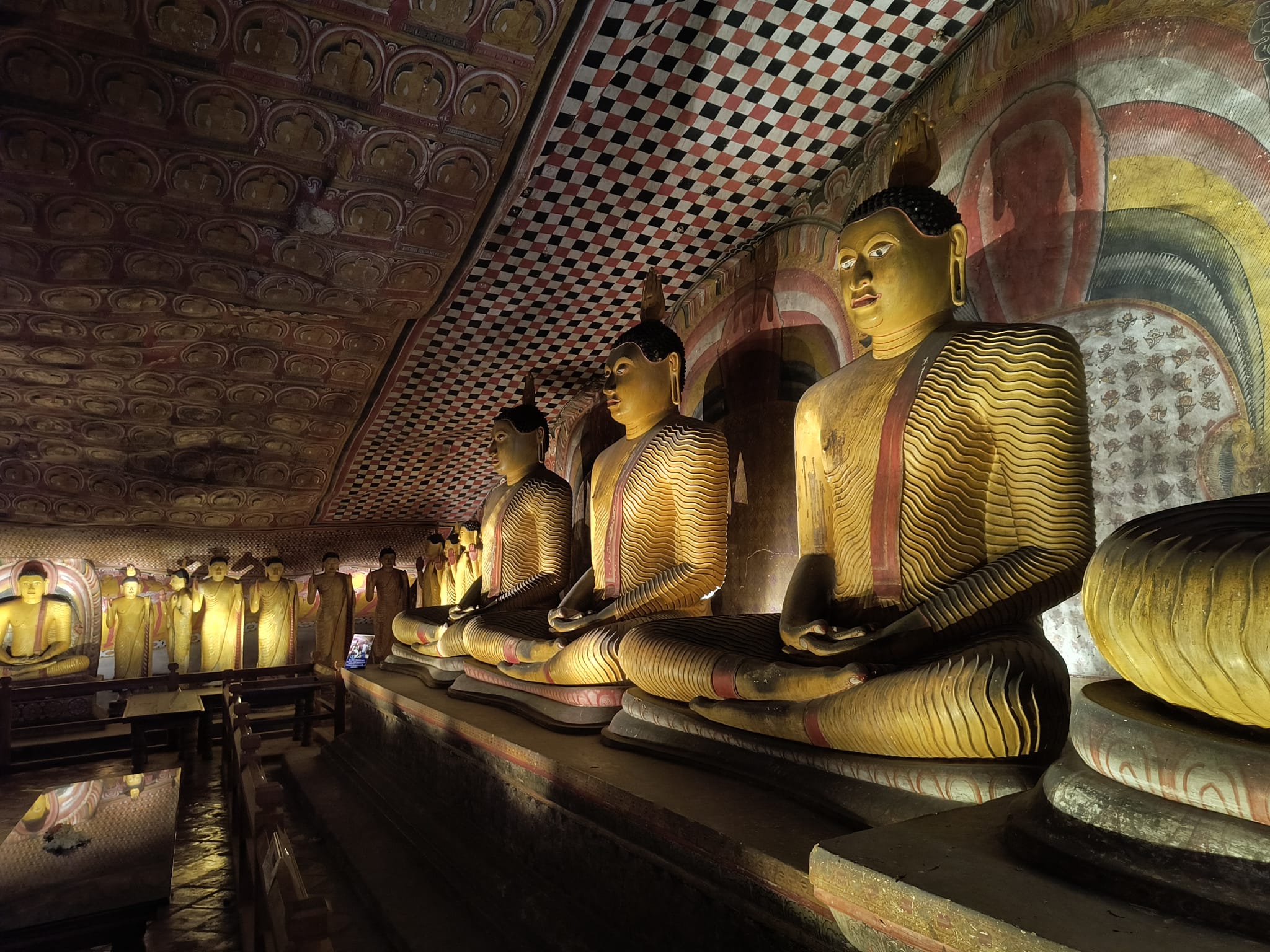
as well as a statue of the King who made all this possible:

But the most impressive of all is the reclining Buddha, which was actually hewn out of the rock. It is incredibly beautiful, even if he only has 9 toes.

We just stare in awe at the cushion on which Buddha rests his head. It is so perfectly carved and decorated that it looks as if it is real. The Fabulosity Meter is having a high old time!
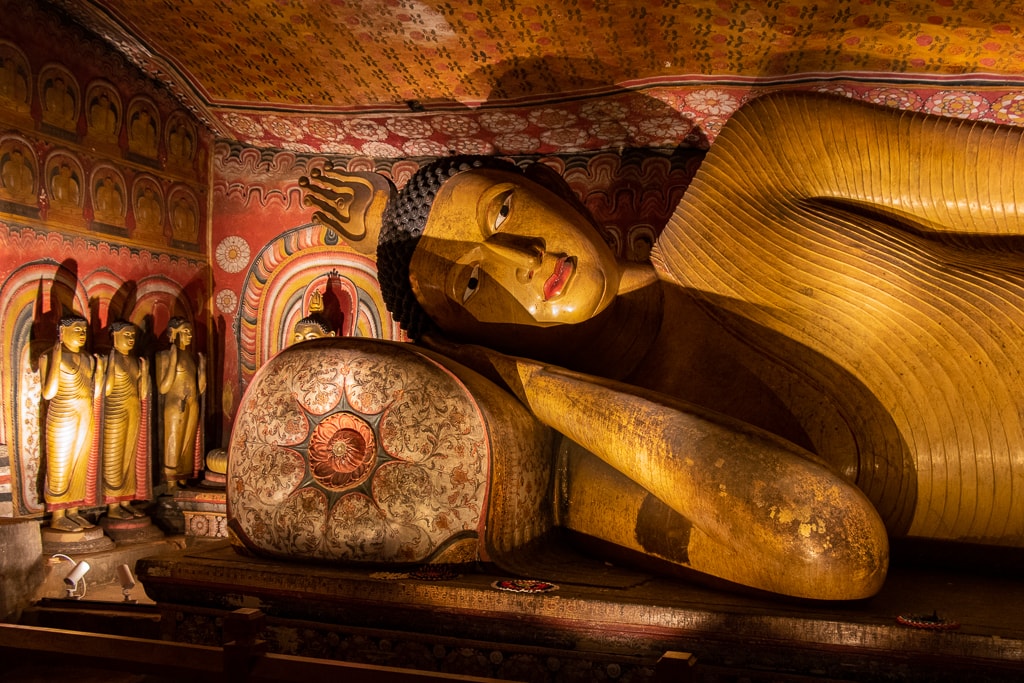
The entire cave ceiling is covered in ornate and detailed depictions of everything from the Buddha’s birth to his temptation by demons to his attainment of enlightenment,

And where the ceiling is too uneven for depictions, every nook and cranny is filled with beautiful geometric designs. All the paintings are so well preserved and the colors are still eye popping. They steal the show for me.

And all created more than 300 years ago in a cave without the benefit of lighting.
Cave 3 is known as the Great New Monastery, although it is smaller than the first two caves, it is perhaps even more dramatic.
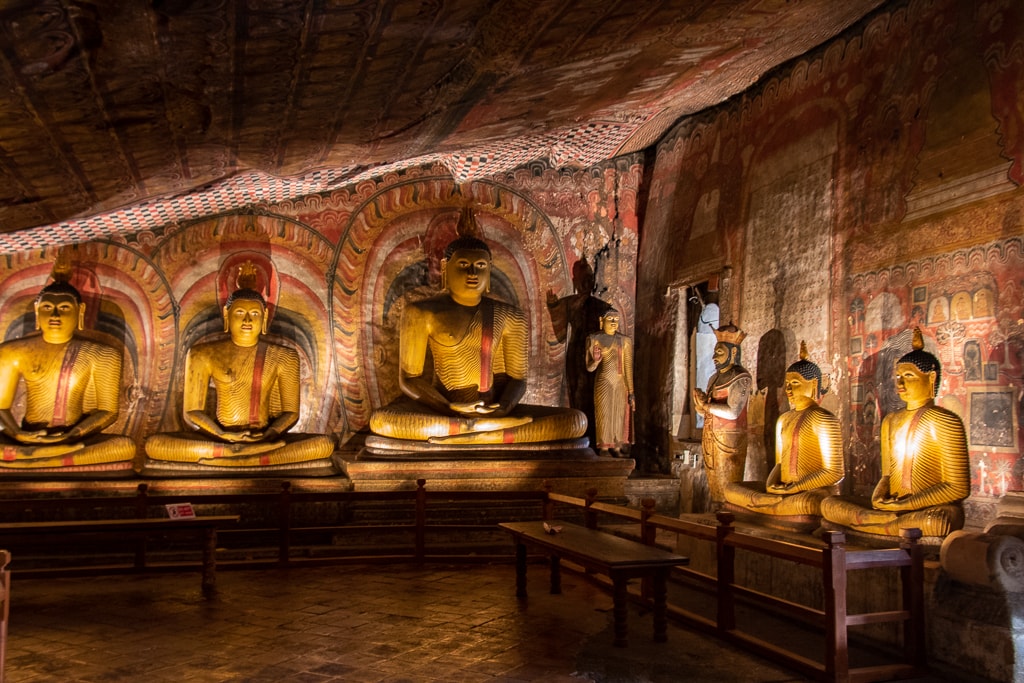
Time has no meaning here. We just wander round in constant awe, while the Fabulosity Meter is making so much noise it is embarrassing. When we finally realise we are tired and thirsty, we look at our watches. It has been three hours since we left Desha.
We venture out rather sheepishly. Desha is on the phone to his wife. He looks up, but makes no effort to end his call. Rather than let him annoy us, we walk across the courtyard to enjoy the view

What a way to end an incredible day.
 Andrews Fabulous Travel Blog
wow…wow…wow!!! sorry to have missed this during my long ago visits. loving the blog, roberto